
Duo Savigni & TouchTheSound Ensemble
Album sponsored by TouchTheSound
This second album, dedicated to Johann Nepomuk Hummel’s music for guitar and piano, focuses on the chamber music works including these two instruments, namely La Sentinelle and the two Grande Serenades en Pot-pourri op.63 and op.66. (The first album, Pot-pourri, Vol.1, is available at the following LINK)
Hummel’s compositions featured on this album represent not only a musical culture but also a distinctive social way of experiencing music. Far removed from the concerns of interpretative authority that would characterise later generations, music by other composers served in this period as a means for each performer to reveal both their own individuality and that of their instrument—an essential opportunity for musical dialogue.
Like the original instruments used for this recording, which—with their strengths and vulnerabilities—challenge musicians to adapt and respond to them, these works invite the discovery of sounds that are at once historical and perpetually new. They are organological and sonic documents that tell the story of a musical practice driven by the desire both to astonish and to be astonished.
The works featured on this recording are representative of the Congress of Vienna and exemplify a collaborative repertoire that brought together the creativity of a circle of musician friends. Approaching this music requires a creative and improvisatory spirit, for it is rich in what remains unsaid and unwritten, leaving performers the freedom to explore and contribute their own voice.
The spirit of this album lies in the joy of creating together and in fostering dialogue among musicians—at times contrasting, at other times harmonious. This is the foundation on which TouchTheSound Ensemble approaches historical performance practice: placing at its centre the richness and diversity of colours, timbres, and techniques that musical notation alone can only partially convey.
In this spirit, we welcome you to our musical salon and invite you to listen to a group of friends playing and conversing through music.
–Duo Savigni
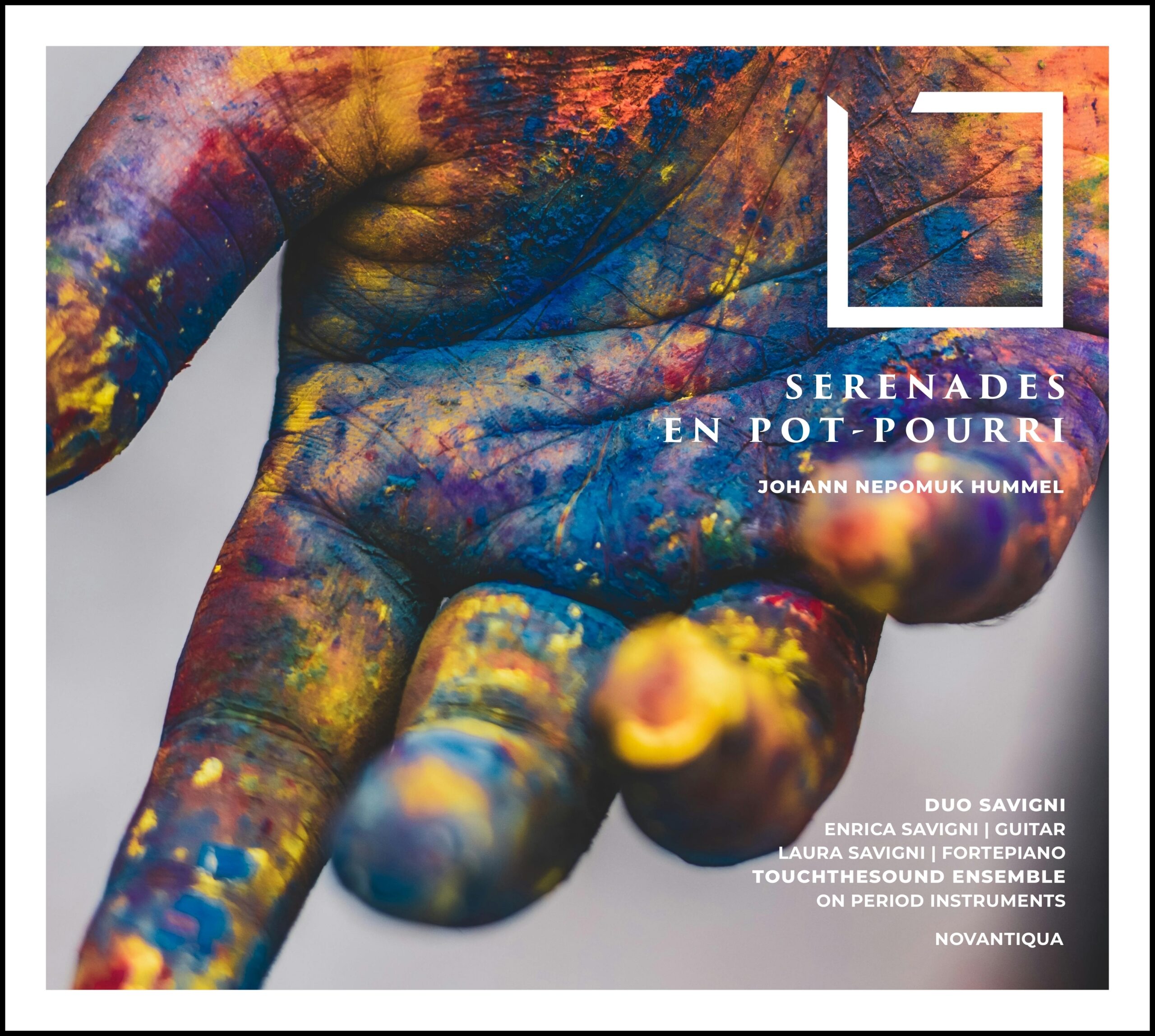
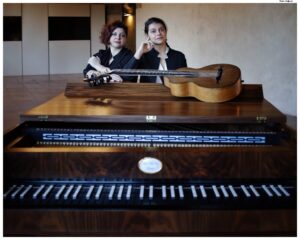
Duo Savigni (Enrica Savigni, guitar | Laura Savigni, fortepiano)
Enrica recorded with a terz-guitar Anton Stauffer, Vienna 1846, Gutstring by Toro Strings; Laura recorded with a fortepiano after Graf 1819 (copy by Paul McNulty)
Duo Savigni, formed by sisters Enrica and Laura, is internationally recognised as leading figures in the revival of the fortepiano and nineteenth‑century guitar repertoire, a field in which they have become reference points for both performance and research. Since 2012, they have devoted themselves to exploring historical instruments, embracing original nineteenth‑century works, rediscovered manuscripts, transcriptions, and contemporary compositions written specifically for this combination. Their artistic identity is shaped by a refined sense of historical awareness and a commitment to expanding the expressive possibilities of the dialogue between fortepiano and nineteenth‑century guitar.
Their regularly participate in festivals, conferences, and are invitated to perform in concert halls and conservatoires across Europe, where they present programmes that illuminate the aesthetics of the nineteenth century while engaging with modern creativity. They collaborate with composers, scholars, and instrument makers, contributing to the broader discourse on historically informed performance and enriching the repertoire available for this unique instrumental pairing. Alongside their performing career, they are active educators, offering masterclasses, lectures, and workshops that reflect their research‑driven approach and their enthusiasm for sharing the sonic world of early instruments.
Enrica’s path includes studies in guitar and clarinet at the Conservatorio “Arrigo Boito” in Parma, followed by specialisation in nineteenth‑century guitar at the Civica Scuola di Musica in Milan and a Master of Arts from the Koninklijk Conservatorium in Brussels. She is currently a DMus researcher at TU Dublin Conservatoire, guitar teacher at Maynooth University and artistic director of the programme Residenze Erranti. Laura began her piano studies at the Conservatorio “Arrigo Boito” in Parma and the Conservatorio “G. Puccini” in Gallarate, later earning a Master’s degree in fortepiano from the Musikhochschule Stuttgart and a Master’s in harpsichord from the Conservatorio “A. Boito” in Parma. She teaches at the Conservatorio “O. Vecchi” in Modena.
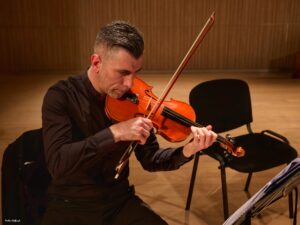
Gian Andrea Guerra, violin
Recorded Serenades opp.63 and 66, with a violin Dante Guastalla (Scarampella’s pupil) Reggiolo 1922
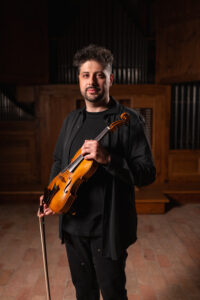
Pierfrancesco Pelà, violin
Recorded La Sentinelle, with a violin after Stradivari (copy by Eduardo Gorr, 2009)
Pierfrancesco Maria Pelà is a violinist and violist specialising in historically informed performance.
After earning his Bachelor’s Degree in violin at the Civica Scuola di Musica “Claudio Abbado” in Milan with Carlo Feige, he continued his studies in baroque violin with Enrico Onofri at the Conservatorio “A. Scarlatti” in Palermo and later at the Conservatorio “E. F. Dall’Abaco” in Verona with Andrea Rognoni and Davide Monti, where he graduated with top honors. He also studied baroque viola with Stefano Marcocchi.
He regularly performs with ensembles and orchestras specializing in early music, including I Barocchisti, EstroVagante, Accademia dell’Annunciata, Bremer Barockorchester, Ensemble Claudiana, La Magnifica Comunità, La Lira d’Orfeo, Accademia La Chimera, Divino Sospiro, Silete Venti, Vox Orchester, Madrigalisti Estensi, Les Furiosi Galantes, and Ensemble Locatelli. He has collaborated with internationally renowned musicians such as Giuliano Carmignola, Enrico Onofri, Diego Fasolis, Stefano Montanari, Luca Pianca, Pablo Valetti, Anton Steck, Ilya Gringolts and Mario Brunello.
He has performed in prestigious theaters and international festivals, including the Festival Oude Muziek Utrecht, Innsbrucker Festwochen der Alten Musik, Händel Festspiele Halle, Auditorium Parco della Musica, and Konzerthaus Dortmund.
He has recorded over 30 albums for labels such as Arcana, Deutsche Harmonia Mundi, PanClassic, Brilliant Classics, Dynamic, and Tactus, receiving excellent reviews and awards from international critics. He regularly performs in duo with organist Nicola Dolci.
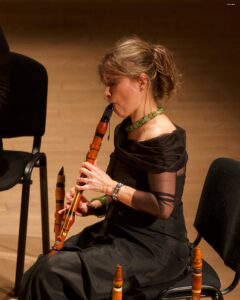
Anna Lycia Gialdi, clarinets
Recorded Serenades opp.63 and 66 with clarinet in Bb, 6 keys, Joseph Baumann, Paris, 1800 ca (op.63); Clarinet in A, 5 keys, W.Schiele, Germany, 1810 ca; Clarinet in Bb, 12 keys, Bühner & Keller, Strasburg, 1815 ca (op.66)
Anna Lycia Gialdi earned her degree in Clarinet and, subsequently, the Chamber Music degree from the Conservatory of Parma (Italy). She studied with F. Meloni and P. Borali and specialised in basset horn, bass clarinet, and Eb clarinet with D. Zanchetta. In 2006, she began studying period instruments (chalumeaux, baroque clarinet, classical and romantic clarinet, and classical basset horn) with Rocco Carbonara and Luca Lucchetta, and in 2014, she earned a first-class honours degree in historical clarinet from the Conservatory of Vicenza (Italy).
She has worked with national and international orchestras on period instruments such as: I Barocchisti, MusicAeterna, Kamerata Megarou Mousikis, Academia Montis Regalis, Patras Barock Orchestra, Oficina Musicum, etc. and with conductors such as: D.Fasolis, T.Currentzis, R.Alessandrini, S.Montanari, etc. With the Kamerata Megarou Mousikis, she played many concerts from Gluck to Beethoven in the role of first clarinet and as a soloist (Vivaldi) and as a basset horn concertante (Beethoven’s Prometheus Creatures) on the Megarou Mousikis Theatre and the Onassis Cultural Centre, the two most important theatres of Athens. With the same orchestra she recorded in 2010 for the label MDG (Musikproduktion Dabringhaus und Grimm), the opera buffa “Don Crepuscolo” by N. Mantzaros, and in 2015 for Deutsche Grammophon, a compact disc of Rossini arias with the great countertenor Franco Fagioli. In 2018, she performed at the Innsbruck Landestheater at the important early-music festival “Festwochen der Alten Musik” with the orchestra Academia Montis Regalis, conducted by Alessandro De Marchi, in the first modern performance of Metastasio’s “Didone abbandonata” with historical instruments, published by Naxos.
In June 2021, she collaborated with the Russian orchestra MusicAeterna, conducted by T. Currentzis, in the performance of Beethoven’s Sixth Symphony for the project “Beethoven Day” conceived and realised by “ARTE Concert”. For RSI (Swiss radio and television) in 2023, she participated in the video recording of Puccini’s “Missa Solemnis” with the orchestra I Barocchisti under the direction of Diego Fasolis, and with the Parisian orchestra Le Cercle De l’Harmonie, she participated in the Ravello Festival 2025 with a romantic Wagnerian repertoire, using original instruments of the period. She worked for international agencies such as Stage Door in Bologna and Parnassus Arts Productions in Vienna.
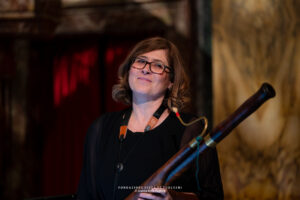
Elena Bianchi, Bassoon
Recorded with a bassoon after Heinrich Grenser (copy by Guntram Wolf)
Elena Bianchi studied baroque bassoon with Lorenzo Alpert at the Conservatoire Populaire de Musique in Geneva, graduating with top marks and a special mention from the jury, and with Alberto Grazzi at the Civica Scuola di Musica in Milan. She also graduated in recorder with Giorgio Pacchioni—under whom she furthered her studies in historical counterpoint and early treatises—at the G.B. Martini Conservatory in Bologna. She holds a degree in musicology from the D.A.M.S. program at the University of Bologna.
She made her debut with the European Union Baroque Orchestra in 1999 and has since pursued an intensive concert career in Italy and abroad (Europe, Egypt, Turkey, the USA, Mexico, Colombia, Korea, Japan, Australia, and Canada), also as a soloist, with various early music ensembles including Ensemble Aurora, Les Musiciens du Prince, Seicento Stravagante, Les Amies Partimentistes, and Ensemble TouchTheSound.
She has collaborated regularly with Concerto Italiano, Concerto Köln, Academia Montis Regalis, Ensemble Elyma, I Barocchisti, the Balthasar-Neumann Ensemble, Le Concert des Nations, Tafelmusik, Accademia Bizantina, Cappella Cracoviensis, and La Risonanza.
She has taken part in numerous radio and recording productions for labels such as Opus 111, Deutsche Harmonia Mundi, Amadeus, EMI Classics, Tactus, Deutsche Grammophon, L’Oiseau-Lyre, Brilliant Classics, Dynamic, Naxos, Glossa, BIS, La Bottega Discantica, Virgin, and ORF.
In addition to teaching courses and masterclasses of international importance—such as Urbino Musica Antica (2015–2019), the Peninsula Summer Academy (Victoria, Australia, 2016), the Tafelmusik Summer Institute (Toronto, Canada, 2019), the International Baroque Academy (Schlitz, Germany, from 2025), and the International Summer School of Early Music Valtice (Czech Republic, 2026)—she has taught at prestigious institutions including the Accademia Internazionale della Musica in Milan and the Haute École de Musique in Geneva (Switzerland).
She is currently professor of historical bassoon at the Hochschule für Musik und Darstellende Kunst in Frankfurt (Germany) and at the Maderna-Lettimi Conservatory in Cesena, and she teaches recorder at the B. Marcello Conservatory in Venice.
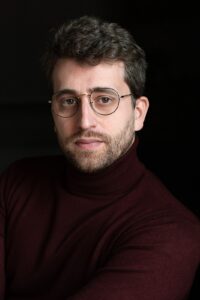
Matteo Straffi, Tenor (Soloist)
Recorded La Sentinelle
Born in Como, he began his musical training at an early age, studying piano, choral repertoire, and solo singing. He studied Renaissance and Baroque singing repertoire at the Conservatorio “G. Cantelli” of Novara (Italy) with countertenor Roberto Balconi, and later specialized in the operatic repertoire with Patrizia Biccirè at the Achille Peri Conservatory of Reggio Emilia. He holds a degree in Cultural Heritage Studies from the University of Milan.
He has performed with ensembles, conductors, and artists including Roberto Balconi (Fantazyas), Evelyn Tubb and Michael Fields (The Consort of Musicke), Alessandro Quarta (Concerto Romano), Eduardo Egüez (La Chimera), Giulio Prandi (Ghislieri Choir and Orchestra), Andrea De Carlo (Ensemble Mare Nostrum), Francesco Corti (Il Pomo d’oro), Ottavio Dantone (Accademia Bizantina), Antonio Greco (Cremona Antiqua Ensemble), Thomas Chigioni (Ensemble Locatelli), and Federico Maria Sardelli (Modo Antiquo).
He regularly performs at international early music festivals such as the Monteverdi Festival (in Cremona), Utrecht Early Music Festival, Grandezze e Meraviglie (in Modena), and Roma Festival barocco. He attended the Advanced Opera Training Academy at Teatro Carlo Felice in Genova for two consecutive years, working with leading artists and debuting in roles in Rossini (Il turco in Italia) and Donizetti (Rita).
His repertoire focuses on Baroque vocal music, both theatrical and chamber, extending to late eighteenth-century and early nineteenth-century Opera.
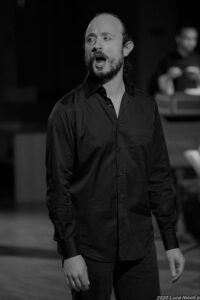
Paolo Davolio, Tenor
Recorded La Sentinelle
A tenor specialised in Renaissance, Baroque, and Classical repertoire, he performs a variety of genres, including madrigals, sacred polyphony, and opera, with particular passion and preference for singing in vocal ensembles with one voice per part.
He graduated in 2017 in Renaissance and Baroque Singing from the “A. Bonporti” Conservatory in Trento under Lia Serafini. He then continued his studies with a first-level Master’s degree in Theory and Practice of Early Music (2018), refining his style and technique with Monica Piccinini, culminating in final concerts within the Grandezze & Meraviglie festival (Modena). He has also had the opportunity to study with other professionals active in early music across Europe, including Gabriele Lombardi, Orlanda Isidro, Magna Ferreira, Mirko Guadagnini, and Luigi Pagliarini.
Among his most important productions as a soloist: first tenor in the Vespers by Giovanni Battista Vitali with I Madrigalisti Estensi for the Utrecht Early Music Festival: Fringe; “First Sailor” in Dido and Aeneas by Henry Purcell for Grandezze & Meraviglie; Tancredi in Il combattimento di Tancredi e Clorinda by Claudio Monteverdi with Furiosi Affetti; tenor soloist in Schubert’s Mass in C major with the Zezere Arts Festival; Orfeo in L’Orfeo dolente by Belli with Bonporti Antiqua Ensemble.
He is a permanent member of the chamber vocal group I Madrigalisti Estensi (dir. Michele Gaddi) and regularly collaborates with the Bologna-based Ensemble San Pietro (dir. Giacomo Contro).
He has collaborated with Ensemble Vox Latina (dir. Maximilina Banos), Ensemble La Chimera (dir. Eduardo Egüez), Dramatodia (dir. Alberto Allegrezza), the National Baroque Orchestra of the Italian Conservatories (dir. Alessandro Quarta), Ricercare Ensemble (dir. Romano Adami), Ensemble Biscantores (dir. Luca Colombo), the vocal ensembles “Allegri Penitenti” and “Exsurge Domine” (dir. Enrico Correggia), and the Choir of the Sistine Chapel.
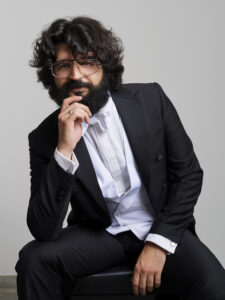
Giacomo Pieracci, Basso
Recorded La Sentinelle
Born in Reggio Emilia, Giacomo Pieracci began his musical training studying both modern and baroque oboe, before turning his attention to opera singing. In 2022, he graduated with highest honors and special distinction under the guidance of Marina Comparato, and also earned a diploma in orchestral conducting with Marco Boni. During his academic studies, he was awarded the “F. Tagliavini” Prize and the “A. Del Rio” Scholarship. He further refined his training with Gabriele Lombardi and Alda Caiello, and took part in masterclasses with internationally renowned artists such as Mariella Devia, Renato Bruson, Carmela Remigio, and Roberto De Candia, as well as pianists and conductors including Enza Ferrari, Raffaele Cortesi, and Marco Boemi. In 2021, he was among the winners of the 75th European Community Competition for Young Opera Singers at the Teatro Lirico Sperimentale “A. Belli” in Spoleto. Since then, he has pursued an intense stage career, making his debut in roles from the Mozart repertoire (Commendatore and Figaro), Puccini repertoire (Angelotti, Zio Bonzo, and Simone), and Rossini repertoire (Norton). Alongside the traditional repertoire, he has maintained a strong commitment to early music, debuting in numerous roles in operas and oratorios by Claudio Monteverdi, Alessandro Stradella, Luigi Rossi, Johann Sebastian Bach, Giovanni Battista Vitali, Francesco Cavalli, among others. He is also active in contemporary opera and 20th-century musical theatre, having taken part in numerous productions featuring works by Benjamin Britten, Gino Negri and Manuel de Falla, as well as world premieres by Salvatore Sciarrino, Fiorenzo Carpi/Giorgio Strehler, Alessandro Solbiati, Voris Sarris, Riccardo Perugini, Martino Traversa, Virginia Guastella, and Fabian Lévy. He has performed in prestigious venues such as the Haus für Mozart and the Mozarteum in Salzburg, the Teatro “R. Valli”and Teatro “L. Ariosto” in Reggio Emilia, the Teatro Olimpico in Vicenza, the Teatro “Pavarotti-Freni” in Modena, the Teatro “A. Ponchielli” in Cremona, the Teatro “G. Menotti” and Teatro “Caio Melisso” in Spoleto, the Teatro Grande in Brescia and Teatro “G. Donizetti” in Bergamo. He has also appeared at major festivals and concert seasons, including the Salzburg Festival, Opéra de Monte-Carlo, Festival Aperto, Monteverdi Festival, Ravenna Festival, Valletta Baroque Festival, Sagra Musicale Umbra, and the Modena Belcanto Festival. He collaborates with ensembles and orchestras such as Il Canto di Orfeo, Icarus ensemble, Ensemble Prometeo, Orchestra di Padova e del Veneto, Orchestra Spira Mirabilis, Filarmonica Arturo Toscanini, Orchestra La Barocca, Camerata Strumentale di Prato, and Cremona Antiqua, Ensemble Locatelli and has worked with conductors including Gianluca Capuano, Marco Angius, Michele Gamba, Jonathan Webb, Antonio Greco, and Jacopo Brusa. He has recorded for Arcana, RAI 5, Tactus, Dynamic, Da Vinci Classics, and Nova Antiqua Records, and has collaborated with stage directors such as Roberto Catalano, Pierluigi Pizzi, Jacopo Spirei, Hanning Brockhaus, Daniele Spanò, Luca Brinchi, and the ANAGOOR collective.
For more info, HERE