The guitar and fortepiano duo was among the most popular instrumental combinations during the first fifty years of the nineteenth century. A vast number of publications were produced for this formation, and many leading virtuosos performed and composed for it, including Giuliani, Hummel, Moscheles, Legnani, Diabelli, and Mertz. Although primarily associated with domestic music-making, bringing together two instruments closely linked to salon culture and women, the duo also featured prominently in public concerts by celebrated virtuosos. This environment fostered a repertoire of remarkable quality. In the first two decades of the nineteenth century alone, more than 300 compositions for this formation were published, ranging from themes and variations, potpourris, and operatic transcriptions to grand duos and sonatas.[1]
Extraordinary organological developments r, particularly involving the piano, resulted in a general and dramatic increase in volume, which together with changing cultural tastes, led to a gradual decline in interest in the guitar as both a solo and chamber instrument, causing it to disappear progressively from the public scene.[2] However, the guitar never ceased to be played in domestic settings, at social gatherings, or as an accompanying instrument for the voice. After its golden age of virtuosos and countless compositions, public enthusiasm declined, fewer composers continued to write for the instrument, and it received almost no public recognition. As a result, the guitar-and-piano duo fell into obscurity for almost a century. It was not until the late 1960s that the Duo Italiano, formed by Rita Maria Fleres on the piano and Mario Sicca on the guitar, rediscovered numerous works and became committed to performing them on a variety of modern and historical instruments.
From the very beginning of its rise, at the turn of the nineteenth century, the guitar occupied an ambiguous position in society. Now equipped with six single strings, the instrument astonished audiences with its versatility. In the hands of extraordinary performers, it was played ‘with unusual grace, skill, and power’,[3] producing both tender melodies and displays of virtuosity, quickly enjoying widespread popularity and finding its way into many households. And yet, despite widespread recognition of the exceptional abilities of its leading performers, critics often condemned these musicians for devoting themselves to what many considered an ungrateful, difficult, and inherently weak instrument, as shown in the following anonymous review of a Giuliani’s concert in 1808:
I, for one, could not avoid thinking, while listening, what Music would have gained if this talent, this incredible diligence and perseverance in conquering the greatest difficulties, had been applied to an instrument more rewarding even to the musician himself. […] We must put the guitar back in its place—let it stick to accompaniment—and we will always be happy to hear it.[4]
Despite this duality, it is undeniable that at the beginning of the nineteenth century, the guitar reached a level of technical and expressive development that shaped a new identity for the instrument. It became capable of extraordinary expressivity and virtuosity, characteristics reflected in the compositional style of the time, dividing audiences between those who could not understand why an instrument traditionally used to accompany songs should be elevated to the concert stage and those who were deeply moved by it in unprecedented ways. Many virtuosos paid little attention to such criticisms and composed remarkable music, attracting prominent performers of other instruments to collaborate with them. The piano world, represented by virtuosos such as Hummel, Moscheles, and Leidesdorf, provides notable examples.
These contrasting reactions should also be understood within a broader contemporary debate between those who valued the performer’s abilities primarily and those who placed greater importance on the music itself, a debate that greatly affected the guitar. Hanson discusses how the increasingly marked division in musical taste in Biedermeier Vienna (referring to the period between 1815 and 1830) resulted from the emergence of more structured musical institutions, such as musical societies, journals, and a conservatoire. She observes the fostering of a distinction between serious art music, largely associated with composers of the recent past and commercial music, which included contemporary virtuoso performers.[5] The guitar and piano repertoire belonged to the latter category, in which the virtuoso was the central attraction: the audience was driven by a desire to see novelty and virtuosity, to be surprised by the performer. For the former, the music to be appreciated was mainly orchestral music; for the latter, it was instrumental ‘entertaining’ music, such as themes with variations, potpourris, and compositions, in which the performer could demonstrate their virtuosic abilities. In an anonymous concert review in the Allgemeine musikalische Zeitung (1808), a critic expressed strong criticisms of Giuliani’s performance:
No one could refuse him his admiration and applause, and the audience showed such enthusiasm as is seldom evoked even by the best masters. Inasmuch as one should acclaim the most outstanding [composition] that has yet been written for and performed on this instrument in Germany—for it is certain that Giuliani has done both—inasmuch, I say, as one should acclaim this, such enthusiasm is to be praised. But if one considers the music itself … Well, just try to imagine a guitar next to an orchestra with trumpets and kettle-drums: isn’t it almost unbelievably amateurish to devote such great talent, as Giuliani has done, to this perennially weak-volumed instrument? Or [for the audience] to take so lively an interest in the virtuoso and his art as to regard his work so highly? [6]
In this review, the reviewer expressed not only scepticism about the guitar performing with an orchestra and attempting to reach a place in musical society where, according to the reviewer, it does not belong, but also criticism of the music itself as of little interest. Although considered the best music composed by Giuliani, it was nevertheless regarded as insufficiently interesting, criticising the ‘amateurish’ enthusiasm of both the performer and the audience for this instrument.
In the piano world, a striking example of the duality between display of virtuosity and musical substance appears in the comparison between Hummel and Beethoven, who, according to Czerny, represented not only two different piano schools in Vienna but also two very distinct compositional styles.[7] In his Recollections of My Life Czerny described the two piano masters, whom he heard perform between 1801 and 1804:[8]
Hummel’s partisans accuse Beethoven of mistreating the piano, of lacking all cleanness and clarity, of creating nothing but confused noise the way he used the pedal, and finally of writing wilful, unnatural, unmelodic compositions, which were irregular besides. On the other hand, the Beethovenites maintained that Hummel lacked all genuine imagination, that his playing was as monotonous as a hurdy-gurdy, that the position of his fingers reminded them of spiders, and that his compositions were nothing more than arrangements of motifs by Mozart and Haydn.[9]
The criticism directed at Hummel’s compositional style resonates with that levelled at his contemporary guitarists. Guitar music, with its potpourris, themes and variations, and dances, was often dismissed as of little interest, with the only undeniable fact being that the hands that played it were incredibly talented. Both reviews are revealing of the debates surrounding a ‘populist’ way of both performing and experiencing music.
The growing popularity of this musical culture contributed to the piano’s rise as the instrument par excellence, achieving tremendous success and requiring larger performance spaces, which eventually led to significant technological developments in the instrument. After 1820, as Huber claims, loudness became the goal, driven by the need to perform in larger halls, for larger audiences, and to increase income.[10] The inadequacy of the guitar in this context is evident from the following review of a Mertz concert in 1851:
A guitar concert in our time, in which music tends towards mass development and in which the greatest effects of the piano pass before indifferent ears, seems to us almost an anachronism.[11]
From the perspective of technological improvements aimed at increasing loudness, the guitar did not enjoy the same fortune. In fact, in the words of the guitarist Makaroff, written around the 1850s:
…in spite of my profound interest in the guitar, I could not help feeling that the guitar as an instrument had come to the end of its life cycle. The realization was very hard to take. I was aware that the pianoforte was constantly being improved and developed, as was also being done with instruments of lesser importance. No one seemed interested enough to improve the guitar. Perhaps this lack of mechanical development was one of the reasons why it was so little in use, or rather, why it had fallen so low.[12]
Many contemporaries of Makaroff considered the rising prominence of the piano as an important reason for the decline of the guitar, which, as Makaroff underlined, did not succeed in keeping apace with the technological development of other instruments. In reference to guitarist Zani de Ferranti, Adolphe Botte, wrote in Revue et Gazette Musicale de Paris in 1859:
They admired the variety of effects, the expressive force, the pathetic, poetic and indescribable accent of this unfortunate guitar, victim of the piano.[13]
In chamber music settings, this also created significant challenges, such as pairing the guitar with a much louder instrument. As Berlioz wrote in 1844, ‘composers scarcely call for it [the guitar] at all, neither in church music nor in the theatre nor in the concert hall’ because of ‘its weak sonority, which prevents it combining with other instruments or groups of voices of normal strength.’[14]
On the one hand, volume contributed to the decline of the guitar (and the guitar-piano duo), on the other, the social perception of the guitar, once regarded as a surprising and captivating instrument was now considered démodé, and this also played a role in its fall into obscurity. In 1855, Charles Philipon addressed this phenomenon in rather explicit terms, presenting a satirical and somewhat grim picture of the guitar’s condition: ‘sentimental souls, late bachelors, troubadours of both worlds, grieve over the guitar’s fate! For thirty years the guitar has been dying, now the guitar is dead!’[15] From around the middle of the nineteenth century, the number of compositions drastically diminished, fewer public performances took place, and some of the instrument’s leading virtuosos devoted their musical and artistic abilities to other activities.[16]
[1] See the attached Catalogue of the Repertoire (Attachment X)
[2] Mantovani, Luiz: ‘Ferdinand Rebay and the Reinvention of Guitar Chamber Music’ (PhD diss., London, Royal College of Music, 2019), 18.
[3] Allgemeine musikalische Zeitung IX (4 Nov 1807), 89, cited in Heck, Thomas F.: Mauro Giuliani; Virtuoso Guitarist and Composer, (Columbus: Editions Orphee, 1995), 38. ‘Among the very numerous guitarists here one Giuliani is having great success, even creating quite a sensation, as much by his compositions for the instrument as by his playing. He truly handles the guitar with unusual grace, skill, and power.’
[4] Allegemeine musikalische Zeitung X (May 1808), 538-39, cited in Heck, Thomas F.: Mauro Giuliani; Virtuoso Guitarist and Composer, (Columbus: Editions Orphee, 1995), 39,40.: ‘I, for one, could not avoid thinking, while listening, what Music would have gained if this talent, this incredible diligence and perseverance in conquering the greatest difficulties, had been applied to an instrument more rewarding even to the musician himself. Has not every instrument its own limits decreed by nature? And if these are violated, must not the result be something strangely artificial, or even deformed? We must put the guitar back in its place—let it stick to accompaniment—and we will always be happy to hear it. But as a solo instrument, it can be justified and appreciated only by “fashion.”’
[5] Hanson, Alice M.: Musical life in Biedermeier Vienna (Cambridge: Cambridge University Press, 1985), 92.
[6] Allegemeine musikalische Zeitung X (May 1808), 538-39, cited in Heck, Thomas: Mauro Giuliani; Virtuoso Guitarist and Composer, (Columbus: Editions Orphee, 1995), 39
[7] Somlai, Petra: ‘Two Viennese piano schools: Beethoven and Hummel’ Research Catalogue: An International Database for Artistic Research, 2019. Accessed 23/08/2026, https://www.researchcatalogue.net/view/555906/559358/0/0.
[8] I first encountered Czerny’s Recollections of My Life (1842) through the article by Petra Somlai, who appears to have relied on the original German source. I subsequently consulted Ernest’s 1956 article, which contains the first complete published English translation. Somlai, Petra: ‘Two Viennese piano schools: Beethoven and Hummel’ Research Catalogue: An International Database for Artistic Research, 2019. Accessed 23/08/2026, https://www.researchcatalogue.net/view/555906/559358/0/0; Czerny, Carl and Sanders, Ernest: ‘Recollections from My Life’, The Musical Quarterly, Vol. 42, No. 3 (Oxford: Oxford University Press 1956),
[9] Czerny, Carl and Sanders, Ernest: ‘Recollections from My Life’, The Musical Quarterly, Vol. 42, No. 3 (Oxford: Oxford University Press 1956), 302-317 (p.309). ‘While Beethoven’s playing was remarkable for his enormous power, characteristic expression, and his unheard-of virtuosity and passage work, Hummel’s performance was a model of cleanness, clarity, and of the most graceful elegance and tenderness; […] It was quite natural, therefore, that the general public preferred him as pianist, and soon the two masters formed parties, which opposed one another with bitter enmity. Hummel’s partisans accuse Beethoven of mistreating the piano, of lacking all cleanness and clarity, of creating nothing but confused noise the way he used the pedal, and finally of writing wilful, unnatural, unmelodic compositions, which were irregular besides. On the other hand, the Beethovenites maintained that Hummel lacked all genuine imagination, that his playing was as monotonous as a hurdy-gurdy, that the position of his fingers reminded them of spiders, and that his compositions were nothing more than arrangements of motifs by Mozart and Haydn.’, cited in Somlai, Petra: ‘Two Viennese piano schools: Beethoven and Hummel’ Research Catalogue: An International Database for Artistic Research, 2019.
[10] Malz, Daniel Adam: ‘Evolution of the Viennese Fortepiano – Alfons Huber Interview’, Classical Cake (2020). https://youtu.be/thB7lhfSgiE?si=_JUwJIS1aBbW7UPv.
[11] ‘Wiener Zeitung’ n.59, from 12 March 1851, p.236, in the section Abendblatt der Wiener Zeitung, as cited in Salvoni, Graziano: Caspar Joseph Mertz: L’ultimo pioniere della chitarra (Lulu.com, 2021), 286.
[12] Bobri, Vladimir, Ulreich, Nura: ‘The Memoirs of Makaroff’, translated from the Russian by Bobri and Ulreich, Guitar Review, Vol.1, n.1-3 (1946-1947), 194.
[13] Van de Cruys, M. G. S., The king’s guitarist: The life and times of Marco Aurelio Zani de Ferranti, Homunculus Wijnegem, 2005, 193. ‘Ils admiraient la variété d’effets, la force d’expression, l’accent pathétique, poétique et indescriptible de cette infortunée guitare, victime du piano’ (Revue et Gazette musicale de Paris, May 1st, 1859).
[14] Berlioz, Hector, and Hugh Macdonald: Berlioz’s Orchestration Treatise. A Translation and Commentary, Cambridge Musical Texts and Monographs (Cambridge: Cambridge University Press, 2002), 86, cited in Mantovani, Luiz: ‘Ferdinand Rebay and the Reinvention of Guitar Chamber Music’ (PhD diss., London, Royal College of Music, 2019), 18.
[15] Charles Philipon, ‘Le Journal pour rire’, n.217 (1855), in Hackl, S., Hofmann, E. P.: The Renewed Guitar – The Instrument’s Evolution Seen Through Period Pictures (1775-1925), (Les Éditions des Robins, 2021), ‘Chapter 7: Caricature and satire: exploiting the guitar’s bad image’, 291.
[16] An example can be seen through some of the leading virtuosos of the mid-nineteenth century, Luigi Legnani, Marco Aurelio Zani de Ferranti, and Giulio Regondi, who started including other activities in their lives. In 1854, is recorded Legnani’s last public performance with the guitar in Ravenna (Monaldini, p.171), after which e entered the Ravenna Orchestra as a viola player until his death; Zani de Ferranti, who had always divided his career between literature and the guitar, did not perform publicly anymore after 18XX; and Regondi, a child prodigy and the last great guitar star in Vienna, focused mainly on the concertina starting from around 1846, with the guitar being used but not exclusively. I need to doublecheck home the exact references
The combination of the nineteenth-century guitar and fortepiano differs profoundly from that of their modern counterparts. With modern instruments, the guitarist usually needs amplification. There are successful duos performing and working with the modern piano and guitar, such as Dúo López de la Osa, who incorporate amplification into their practice. Otherwise, as I have experienced myself in the past, playing modern instruments without amplification requires constant work on balance, continually pushing the guitar to its loudest dynamics and the piano to its softest, barely exploring the full dynamic range of either instrument.
With historical instruments, something completely different happens, beyond the stereotype of the weak guitar and the overly powerful piano. In general, the volume of fortepianos and guitars, compared with their modern counterparts, was more balanced. This complementarity of sound and projection was one of the principal reasons for the success of the nineteenth-century guitar-piano duo. An essential aspect to consider is that nineteenth-century fortepianos and guitars varied widely, with different models presenting distinct sonic and timbral qualities, making it difficult to refer to a single sound world for the fortepiano-guitar combination. There were grand pianos and square pianos with varying numbers and types of pedals, as well as guitars tuned a third higher (terz guitars) or with additional bass strings. From a performer perspective, this is what makes this formation so interesting: the numerous ways to pair these instruments leave room for imagination and creativity. Among these possibilities, this research places particular emphasis on Viennese instruments.
The pedals and knee levers of Viennese instruments are an essential sound component of the fortepiano and function effectively within the duo combination. Around the late 1790s, tone colour became an important aspect of piano design, which led to the introduction of pedals.[1] No standard number of pedals existed, as both their number and type could vary. In the instruments Laura, my duo partner, and I have played so far, we have encountered many pedal effects, such as the janissary (or turcherie) and bassoon, which led us to explore less conventional sound combinations. In the grand piano we use most frequently, a copy by Paul McNulty of an 1805 Viennese fortepiano by Anton Walter, there are two knee levers: the forte and the moderator (sometimes referred to as the celeste). The first is the equivalent of the modern sustaining pedal, allowing the strings to vibrate freely, while the second places a piece of felt between the hammers and the strings. The moderator produces a particularly distinctive sound: it slightly reduces the volume of the instrument but more importantly, it creates a drastically different sound effect, resulting in a muffled tone. The moderator’s effect is especially relevant with the guitar, as it creates a sound that contrasts strongly with the guitar’s defined, percussive attack.
Czerny, in his Metodo Completo op.500, wrote about the moderator, referring to it as the piano pedal, that ‘this pedal is used more rarely than any of the others, and its most appropriate use is in a very soft tremolo in the lower register, combined with the damper pedal, so as to produce the effect of distant thunder.’[2] Hummel makes a similar description, referring to the damper pedal and piano pedal, stating that ‘though a truly great Artist has no occasion for Pedals to work upon his audience by expression and power, yet the use of the damper pedal, combined occasionally with the piano pedal (as it is termed), has an agreeable effect in many passages.’[3]
This mysterious, resonant sound contrasts sharply with that of the Viennese guitar, usually characterised by a very defined, percussive tone. The contrast is even more pronounced with the terz guitar, a smaller instrument tuned a minor third higher, for which much of the repertoire was written. This ‘modern terz guitar’, as defined by Giuliani,[4] was introduced around 1810 and was strongly promoted by players, composers, and guitar makers such as Giuliani, Leonard von Call, Diabelli and Stauffer. As defined by Fétis in the Revue Musicale:
The purpose of this new design of the instrument is to produce a brighter, more brilliant tone, but this can only be achieved at the cost of the sweetness and warmth that are already far too uncommon in ordinary guitars.[5]
The Viennese and German repertoire for guitar and piano made extensive use of this instrument until the middle of the century. Its higher pitch and greater projection became important qualities in combination with the continually improving and increasingly louder piano.
While guitar makers sought greater projection through the development of instruments such as the terz guitar from around 1813 onwards, Viennese piano makers were still pursuing a very different sound ideal. The Viennese piano-building tradition favoured instruments with a lighter touch compared to those of the English school. In his 1827 Methode, Hummel wrote that:
The Viennese instrument allows itself to be handled with ease by the lightest hands. It … does not obstruct velocity through too great an effort… The English action must be done equal justice because of its durability and fullness of the tone. However, these instruments do not allow for the same level of fluency as the Viennese, since the touch of the keys feels noticeably weightier, while they also fall much deeper, so that as a result the escapement of the hammer is not fast enough with repetition. [6]
Viennese fortepianos, with their light construction, are characterised by a percussive sound, tonal clarity, and rapid sound decay. As described by Alfons Huber, the Viennese action ‘is very, very vivid and accurate and it follows much more the intention of the fingers’, emphasising that in the Viennese sound concept, ‘loudness is not the goal, it is not a problem, it is not a theme: loudness is not a form of quality.’[7] Earlier instruments favoured ease of touch and a close connection between the player and the instrument, at the expense of greater volume.
An interesting feature of these instruments was the so-called Schalldeckel, a removable second soundboard placed over the strings.[8] According to Huber and Honheisel, the Schalldeckel was characteristic of early Viennese pianos, and was adopted to ‘regulate the sound balance between the treble and bass ranges, especially when playing with the main lid open.’[9] The famous piano tuner Claude Montal wrote in 1836 that:
Its function is to modify the quality of the sound and to increase its volume slightly. […] It is this soundboard which, by adding its own vibrations to those of the strings, gives life to the instrument and determines the strength and duration of the sound.[10]
In Montal’s experience, the second soundboard increased the instrument’s volume and affected its tone production. It may therefore have helped retain vibrations within the instrument, creating a more resonant response and a stronger interaction with the sound for the player. Significantly, these developments do not seem primarily aimed at projecting more sound towards an audience. Rather, they reflect a Viennese sound ideal centred on responsiveness and tonal variety. Guitar makers, by contrast, devoted considerable effort to increasing the projection and carrying power of their instruments.
The guitars of nineteenth-century Vienna, in fact, were built with the aim of obtaining the maximum possible volume from the instrument while projecting sound as efficiently as possible towards the audience. Because of their design and structure, these guitars are particularly effective in lyrical passages, offering clarity in melodic lines and in the lower register, with less resonance than modern guitars. The most important builder, and the one who set the standard for the Viennese guitar school, was Johann Georg Stauffer (1778-1853), followed by his son Johann Anton Stauffer (1806-1871). Georg Stauffer was an extraordinary innovator and visionary, dedicated to experimentation throughout his life. He collaborated with leading performers of the time, such as Mauro Giuliani and Luigi Legnani, developed the first guitar with two additional bass strings (1825) [11], experimented with new designs (Doppelguitare, 1807)[12] and was also known as the inventor of the arpeggione. His son, Johann Anton, a young fortepiano performer,[13] built guitars following his father’s idea of creating instruments with great projection and efficiency. Stauffer guitars featured a double back, a light structure, and a very solid soundboard, producing instruments with a clear, powerfulsonority. This concept of construction reached its apex with the last instrument of Georg Stauffer, made in 1850 and developed over several years together with his son Anton: an oval-bodied guitar with additional bass strings, an adjustable neck, and a second back ‘fitted behind the first and fixed to it only by a few braces around the periphery.’[14]As Hackl describes, ‘the role of the second back is to protect the first from contact with the player, so as to avoid damping out its resonance’, [15] [16] This can be understood as the Stauffers’ attempt to realise the most effective and powerful instrument possible, perhaps in response to the increasing prominence of the piano. Yet, despite these efforts, the guitar did not regain its position in dialogue with the piano.
Although the guitar has always been considered a weak instrument, I believe that performers can, under certain circumstances, develop specific abilities in playing an instrument, responding to a particular environment in ways that transform both technique and sound into something effective. From my own experience performing with many different types of fortepianos, I have found that I have had to develop an approach to playing that differs from the one required in solo performance. My Spanish guitar, a Hijos de González dating from around 1880, which I used to begin this research, is a striking example. On many occasions, after trying this instrument, many colleagues have commented on its sweetness and quietness, expressing surprise that, when paired with the fortepiano, I was able to make it project and function so effectively. By this I do not mean that I possess any special ability. Rather, I believe that particular necessities and performance conditions can teach a player how to make an instrument function at its extremes, in ways that may initially seem unexpected. Evidence for this is that, although the guitar was often criticised for its weakness, figures such as Giuliani and Mertz were never criticised for a lack of volume when performing with the piano. As a performer seeking to engage with this instrumental formation, I have found that grasping an instrument’s sound effectively requires time and experimentation.
My experience performing in a duo with the fortepiano leads me to believe that this formation encourages a manner of playing that promotes sonic experimentation and attentive listening. It invites the performer to explore levels of projection, dynamics, and tonal qualities that, in a solo context, I might previously have considered inefficient or even undesirable. In our work together, my piano partner Laura and I play many different instruments and pair those that, historically, could have been played together, such as Viennese fortepianos by Graf (1819), Streicher (1814), and Schanz (1825) with Stauffer guitars (Georg Stauffer, 1825, and Anton Stauffer, 1840, 1841, and 1846). We also experiment with combinations that cross periods and geographical contexts. [17] This strategy allows us to perform mid-nineteenth-century repertoire and explore timbres that would otherwise be extremely challenging to realise, as by that time the two instruments had almost completely ceased to function effectively together. Through this approach, sound balance itself becomes one of the primary tools of expression. While the sound aesthetics of the period are undoubtedly important and necessarily influence performance practice, I consider balance to be a fundamental parameter in the expressive relationship between the two instruments. In this work, we create new sound combinations that deliberately inform both our performance decisions and transcription choices. Nevertheless, this approach aligns with the period’s attitude, in which performers worked with the instruments available to them, reacting and adapting to their sounds.
[1] Malz, Daniel Adam: ‘Evolution of the Viennese Fortepiano – Alfons Huber Interview’, Classical Cake (2020), 11’23’’,https://youtu.be/thB7lhfSgiE?si=_JUwJIS1aBbW7UPv.
[2] Czerny, Carl: Metodo Completo Teorico-Pratico per il Piano-Forte op.500, (Milano: Ricordi, 1839), Book III, 62 (Translation generated by Copilot, September 13, 2026).
[3] Hummel, Johann Nepomuk: A Complete Theoretical and Practical Course of Instructions, on the Art of Playing the Piano Forte (London: Boosey & C.,1828), Part III, 62.
[4] Heck, Thomas: Mauro Giuliani; Virtuoso Guitarist and Composer, (Columbus: Editions Orphee, 1995), 116.
[5] Fétis, François-Joseph: Revue Musicale, Paris, 1828, vol.111, n.8, p.156, in Pieters, Peter: ‘La chitarra terzina nella prima metà del secolo XIX’, Il Fronimo, n.73 (Milano: Edizioni Suvini Zerboni, 1990), 39. ‘Le but de cette nouvelle disposition de l’instrument est d’obtenir une vibration plus éclatante; mais elle ne pouvait être acquise qu’au détriment de la douceur et du moelleux qui ne sont déjà trop rares dans les guitares ordinaires.» (Translation generated by Copilot, 14 September 2026).
[6] Hummel, Johann Nepomuk: Anweisung zum Piano-Forte-Spiel (Vienna: Haslinger, 1827), 454, in van Oort, Bart: ‘Haydn and the English Classical Piano Style’, Early Music, Vol. 28, No. 1, (Oxford: Oxford University Press, 2000), 75.
[7] Malz, Daniel Adam: ‘Evolution of the Viennese Fortepiano – Alfons Huber Interview’, Classical Cake (2020), 7’13’’, https://youtu.be/thB7lhfSgiE?si=_JUwJIS1aBbW7UPv.
[8] Honheisel I., Huber A., ‘The Restoration of the Fortepiano by Nannette Streicher Opus 961, Vienna 1813 (SAM 844)’, in Technologische Studien, KHM-Museumsverband, 2021, 171.
[9] Honheisel I., Huber A., ‘The Restoration of the Fortepiano by Nannette Streicher Opus 961, Vienna 1813 (SAM 844)’, in Technologische Studien, KHM-Museumsverband, 2021, 171.
[10] Montal, Claude: L’art d’accorder soimême son piano (Paris: Meissonnier, 1836), 14. (Translation generated by Copilot).
[11] Hackl, S., Hofmann, E. P., Mougin P.: Stauffer & Co. – The Viennese Guitar of the 19th Century, (Les Éditions des Robins, 2012), 62.
[12] Hackl, S., Hofmann, E. P., Mougin P.: Stauffer & Co. – The Viennese Guitar of the 19th Century, (Les Éditions des Robins, 2012), 62.
[13] Hackl, S., Hofmann, E. P., Mougin P.: Stauffer & Co. – The Viennese Guitar of the 19th Century, (Les Éditions des Robins, 2012), 64.
[14] Hackl, S., Hofmann, E. P., Mougin P.: Stauffer & Co. – The Viennese Guitar of the 19th Century, (Les Éditions des Robins, 2012), 90.
[16] Hackl, S., Hofmann, E. P., Mougin P.: Stauffer & Co. – The Viennese Guitar of the 19th Century, (Les Éditions des Robins, 2012), 90.
[17] For a list of the instruments used during this DMus research project, see ‘Table of Instruments’, page X.
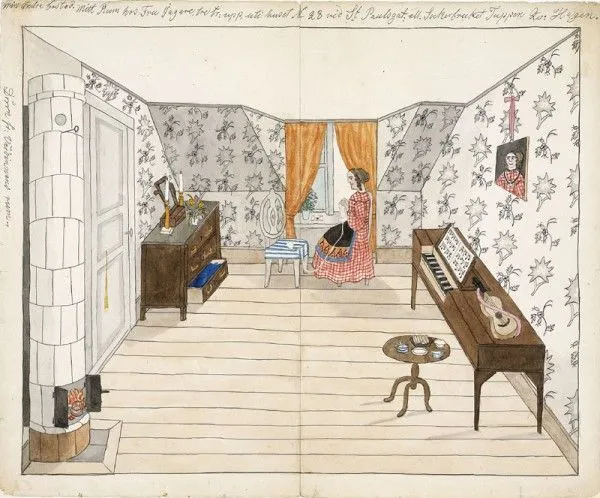
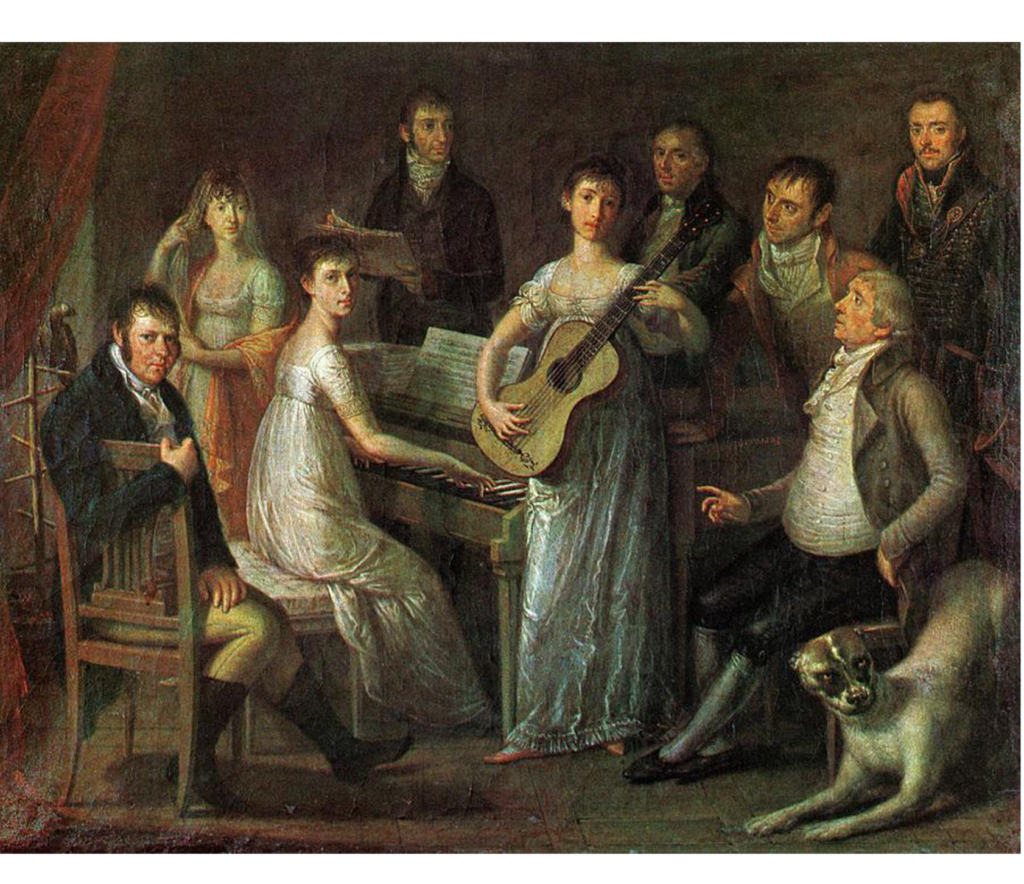
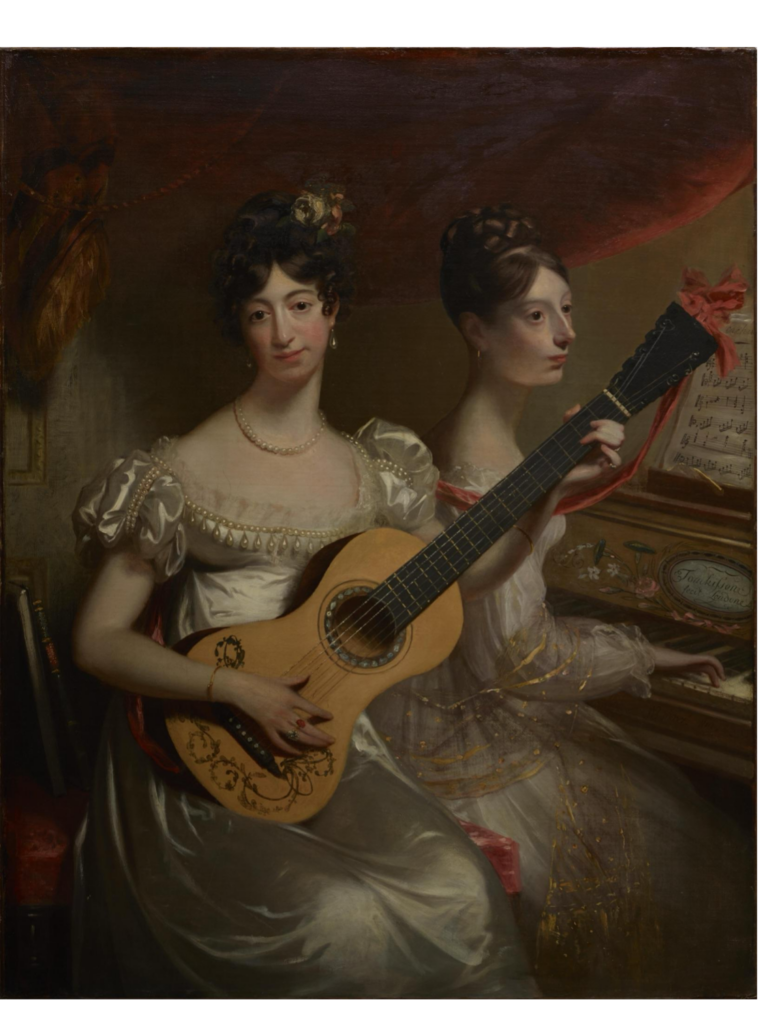
The ensemble’s domestic nature is reflected not only in written sources but also in visual representations. Paintings depicting guitar and piano performance provide valuable evidence about both the duo’s social context and its performance settings.[1] Some particularly interesting paintings depict women performing guitar and piano together: the Malfatti sisters[2] (Fig. 2), the Madame Plowden[3] (Fig. 3), the French drawing ‘Costume Parisien’[4] (Fig. 4), and the painting ‘Terzett’[5] (Fig. 5).
These paintings offer many observations worth discussing. First, the combinations of instruments depicted vary widely. Guitars are paired with both square pianos (Figs. 3 and 5) and larger keyboard instruments (Figures 2 and 4). In Figure 2, for example, Therese Malfatti plays a Viennese fortepiano while Anna Malfatti plays an Italian guitar model similar to those Gennaro Fabricatore produced in Naples around 1800.[6] In Misses Plowden’s painting (Fig. 3), Hofmann and Hackl note that Anna Maria Plowden plays a Spanish six-course guitar fitted with single strings, while the lady on the right plays an English fortepiano by Thomas Tomkinson.[7] In Figure 5, the guitar could be an instrument made in Mirecourt between 1805 and 1810, by Laurent Blaise or Michel Lutzemburg, as suggested by Hofmann and Hackl,[8] while Figure 4 depicts a French five-course guitar equipped with five single strings paired with a late eighteenth-century French or English square fortepiano. Taken together, these examples reveal a remarkable variety of instrumental combinations, allowing us to imagine a wide range of possible sonorities.
An interesting aspect of the keyboard instruments depicted in these paintings is that they all appear with their lids closed, not only in these images but also in Figs. 6, 7, and 8. This may be because the keyboard instrument was expected to play more quietly when paired with the guitar, or because greater volume was unnecessary in a salon setting. However, as Richard Burnett has argued, it may also reflect a broader social preference for concealing the mechanism from view.[9]
Visual evidence of guitar and piano performance places this repertoire largely in domestic settings. Contemporary reviews and correspondence, however, reveal that the guitar-piano duo also appeared in larger concert venues. Performers like Giuliani, Hummel, Moscheles, Mertz, and Plantin played in venues such as the local theatre in Baden,[10] the Small Redoutensaal,[11] the Gesellschaft der Musikfreunde in Vienna,[12] the Alte Residenz in Salzburg,[13] the Esterházy Palace,[14] and outdoor settings in Baden[15] and in the Botanical Gardens in Vienna.[16] There is little information about the instruments these virtuosos used when they performed together. In the case of Giuliani with Hummel or Moscheles, it would seem likely that they paired Viennese instruments, such as a Stauffer terz guitar with Viennese fortepianos, but this is speculation. However, it is known that Mertz and Plantin performed on a Stauffer terz guitar with keyboard instruments by Bösendorfer, Schweighofer, and Schrimpf.[17] While information about stage arrangements is scarce, Plantin’s memoirs provide a rare glimpse into their disposition within an ensemble setting:
My husband also wrote effective quartets for two mandolins, guitar, and piano, which we performed three times a week at Count Ledochowsky’s residence. The Count sat to my right playing the second mandolin, the Countess to my left playing the first mandolin, my husband at the far end with the guitar, and I in the middle at the piano. I was the one who suffered most, however, because whenever the Count lost his plectrum or his mandolin slipped, he would bellow a thunderous “Stop!” and grab me by the arm with such force that I rarely got away without a bruise.[18]
Another aspect worth discussing is the remarkable variety in the guitarist’s position, both in the way the instrument is held and in the performer’s placement relative to the pianist. The guitarists are depicted standing (Fig. 2), sitting in front of the pianist (Fig. 5), using a footstool (Fig. 4), or playing with a strap while seated almost back-to-back with the pianist (Fig. 3). This diversity suggests that playing positions had not yet been standardised. As Franz Xaver Knize remarked in 1820, referring to contemporary guitar practice, ‘there are nearly as many ways to hold the guitar, as there are guitar players.’[19]
In my practice with Laura, I have adopted several of these positions and performance settings, including sitting next to Laura (Video Ex. 1), sitting in the coda (Video Ex. 2), standing, and performing with the fortepiano lid removed and Laura facing the audience (Video Ex. 3 and 4). In a traditional performing setting, where the audience is positioned in front of the stage, I mostly stand, placing myself at the tail of the instrument when performing with a grand piano (Video Ex. 5), or closer to the front when performing with a square piano (Video Ex. 6). Our experimentation with different positions has been closely connected to two main elements. The first is the performance spaces we have worked in, awhere we sought the most suitable arrangement based on the instruments’ sound projection and the audience’s placement, an aspect that can also be observed in the paintings. In Video Ex. 1, we performed in an open space during an art exhibition. With audience members standing around us, I sat close to Laura in order to engage with those positioned behind the fortepiano. The second factor is the music being performed. Certain characteristics of the musical writing may suggest one position rather than another. In Video Ex. 2, the piece performed is Ferdinand Rebay’s transcription of Beethoven’s Sonata Op. 90 for guitar and piano. In this case, the musical material is distributed very evenly between the two instruments, creating a strong sense of dialogue. From my perspective, this balance would be disrupted by the visual prominence of a standing guitarist, whereas seating both performers helps maintain a greater sense of equality between the two roles.
Each setting has advantages and disadvantages, and I believe that an ideal arrangement exists only in relation to a specific performance space. An ideal arrangement occurs when, in rehearsal, we perform almost face to face (as in Fig. 2 and Video Ex. 7). This position allows more direct communication between the performers, but it would be less effective in a conventional stage setting, as it would require the piano to be placed at an angle that could compromise the direction of its sound. This tension between communication and acoustic considerations is one reason I usually perform standing with a strap, as it gives me greater freedom of movement to adapt in response to the venue.
Although iconographic and organological evidence suggests that guitarists sometimes performed with a strap, neither guitar methods nor concert reviews clearly describe guitarists performing while standing in official concert settings. Instead, guitar methods generally recommend a seated posture and often give specific instructions on how to hold the instrument.[20] However, such methods do not necessarily reflect the actual practice of virtuoso performers in terms of posture and technique, as they were primarily intended to introduce beginners to the instrument. Nevertheless, both iconographic evidence and surviving instruments, many of which preserve features designed to accommodate a strap, suggest a more varied reality. The visual evidence points to a broader range of performance practices than pedagogical sources describe, with guitarists standing or sitting, with a strap or without, with a footstool under the right leg, the left leg, or none at all.
Standing guitarists also appear in the frontispiece of Hummel’s Grande Sérénade op.63 published by Artaria (Figure 6). The evidence for a standing performance position appears not only in the frontispiece but also in the scores. In fact, in the Grande Sérénade op.66, during the March Les deux journeès, the guitarist, together with the other musicians except for the pianist, is instructed to move away and then return.[21] In the drawing of Hummel’s publication, the guitarist stands to the side of the piano facing the pianist, similar to the guitarist in Malfatti’s painting (Figure 2), the Group Portrait [22](Figure 7) and in an anonymous Tyrolean painting [23] from Stefan Hackl’s collection (Figure 8)
When observing a standing performer, the first impression is that of the greater freedom of movement that this position affords. At first glance, it appears primarily as a visual feature, however, as previously explored, this position affects the acoustic relationship with the performance space. When performing in venues without an elevated stage, I find it essential to stand. Being positioned higher allows me to remain visible to the audience and enables the sound hole of the guitar to project above the listeners’ heads. Likewise, positioning myself near the tail of the grand piano significantly affects the performance experience, feeling integrated into the fortepiano’s sound. The effect is almost as though the fortepiano’s resonance extends the guitar’s sound toward the audience. In some respects, the guitar sound appears to follow the trajectory of the sound emerging from the tail of the piano. If seated, by contrast, the two sounds would remain much more separated, losing the opportunity for a greater fusion of timbres.
This placement also affects my playing significantly. Experiencing such a strong sonic presence from the fortepiano encourages me to project more, to engage more actively with the instrument’s resonance, and ultimately to perform with greater energy.
The freedom of movement afforded by the standing position has also proved important for expressive and musical reasons. During passages in which the piano assumes a more prominent role, I can step slightly aside; when the guitar takes on a solo function, I can move forward. I can also adjust my proximity to my partner, either drawing closer or moving further away depending on the musical situation. In this way, physical space becomes another way to support the performance’s expressive intentions. Particularly in performances with larger ensembles, such as Hummel’s Grande Sérénade, where the guitar alternates between solo passages, accompaniment roles, and extended periods of rest, adopting a mixed performance position (alternating between sitting and standing) can be an effective strategy. From a sonic perspective, standing and stepping slightly forward helps the guitarist project more efficiently; at the same time, it draws more visual attention, which can in turn enhance the overall impact of the performance (Video Ex. 8).
There are, however, certain disadvantages to performing while standing. The strap creates additional tension by pulling the neck back, thereby increasing the strain on the instrument. Over a prolonged performance, such as a one-hour programme, this additional tension can reduce the sound’s brilliance. This effect is particularly noticeable on the terz guitar, an instrument that already operates under considerable tension. Such brilliance is one of the terz guitar’s most valuable qualities, especially when performing alongside a large fortepiano.
To mitigate this issue, I alternate between standing and sitting on a high stool (Video Ex. 9), perhaps comparable in height to the seat depicted in the ‘Costume Parisien’ (Figure 4). Using a high stool lets the instrument rest occasionally on the right thigh, reducing the extra strain imposed by the strap while maintaining an elevated playing position. Moreover, the player’s body interferes less with the instrument’s vibration than in conventional seated playing. This approach recalls the acoustic principles embodied in Georg Stauffer’s double-back guitar designs of the 1850s.
[1] Hackl, S., Hofmann, E. P.: The Renewed Guitar – The Instrument’s Evolution Seen Through Period Pictures (1775-1925), (Les Éditions des Robins, 2021)
[2] Malfatti Family, 1810c., Private Collection. (Therese at the piano, Anna with the guitar, and family members), in Hackl, Hofmann, 120.
[3] William Beechey, The Misses Plowden, 1819, Collection: Dallas Museum of Art. https://dma.org/art/collection/object/4060166, in Hackl, Hofmann, 121
[4] Costume Parisien, 1801.
[5] Terzet, c.1840, by Ditlev Conrad Blunck (1798-1854), probably Copenhagen or Berlin, in Hackl, Hofmann, 59
[6] Hofmann, Hackl, p.120
[7] Hofmann, Hackl, p.121. Although it is unclear whether the keyboard instrument is a square piano or a grand piano, as Tomkinson manufactured both types, I argue that, because the guitarist sits behind the pianist, the musician on the right is playing a square piano.
[8] Hofmann, Hackl, p.49
[9] Burnett, Richard, Company of Piano, I need to check the exact page in the book at home
[10] Heck, Thomas: Mauro Giuliani; Virtuoso Guitarist and Composer, (Columbus: Editions Orphee, 1995), 94.
[11] Heck, Thomas: Mauro Giuliani; Virtuoso Guitarist and Composer, (Columbus: Editions Orphee, 1995), 98.
[12] Salvoni, Graziano: Caspar Joseph Mertz: L’ultimo pioniere della chitarra (Lulu.com, 2021), 285.
[13] Salvoni, Graziano: Caspar Joseph Mertz: L’ultimo pioniere della chitarra (Lulu.com, 2021), 349.
[14] Salvoni, Graziano: Caspar Joseph Mertz: L’ultimo pioniere della chitarra (Lulu.com, 2021), 281.
[15] Heck, Thomas: Mauro Giuliani; Virtuoso Guitarist and Composer, (Columbus: Editions Orphee, 1995), 94.
[16] Heck, Thomas: Mauro Giuliani; Virtuoso Guitarist and Composer, (Columbus: Editions Orphee, 1995), 65.
[17] Salvoni, Graziano: Caspar Joseph Mertz: L’ultimo pioniere della chitarra (Lulu.com, 2021), XX
[18] LETTER, thanks to Petra Polackova for pointing out to me this section. Translation generated by Copilot (13 October 2026). I have to contact Petra
[19] Hackl, S., Hofmann, E. P.: The Renewed Guitar – The Instrument’s Evolution Seen Through Period Pictures (1775-1925), (Les Éditions des Robins, 2021).
[20] The strap, or the ribbon, was often associated also with the seated position. The mention of the strap appears in only a few methods: one famous example is the Molino method, where he writes that: ‘In order to facilitate the movement of the left hand still further, the strap should be used, at least during the first months, so that the guitar may be supported more comfortably.’ (Translation generated by Copilot, 10 October 2026). ‘…per facilitare sempre piu il movimento della mano sinistra si dovrà far uso del nastro, almeno per i primi mesi onde sostenere piu comodamente la Chitarra’, Molino, Francesco: Nouvelle Méthode pour la Guitare (Paris: Gambaro, 1814), 18.
[21] Penn, Gerhard: Serenades – Hummel’s works with guitar and piano Vol.2, Duo Savigni and TouchTheSound Ensemble, 2026, p.6: ‘Les deux journées (Allegro, track 8, 4:00): March from the final act of Luigi Cherubini’s (1760–1842) opéra-comique Les deux journées, ou Le porteur d’eau. With this march, the musicians, who are initially gathered around the piano, have to move away, one after the other, the guitarist to one side, the others on the opposite side’ […] ‘March de Nadermann (Allegro moderato, track 10, 2:16): […] During the march, the instruments gradually draw together and finally assemble around the piano. The guitar presents the first measures of the march as a solo instrument, later accompanied only by the violin, with some decorative figures. Finally, all instruments take over the theme in a slow crescendo. The scene bears a striking resemblance to Boccherini’s music for La Ritirata di Madrid.’
[22] Russian School, circa 1800, A Group Portrait of the Bookseller Ernst Wilhelm Ziemssen with his Family, Rafael Valls art gallery, London.
[23] Anonymous, Hall (Tirol), c.1820, Private Collection Stefan Hackl.